The Transformation Imperative: From Chaos to Structure


Understanding the Structural Divide
The fundamental difference between structured and unstructured data lies not just in organization, but in immediate usability for business applications. Structured data is organized in a clear, predefined format, conforming to fixed schemas where data elements are categorized into rows and columns. This organization makes structured data easily decipherable by data analytics tools, machine learning algorithms, and human users, enabling rapid analysis and decision-making.
Unstructured data, in contrast, lacks a predefined data model or organization and doesn't fit into conventional database structures. This fundamental difference creates unique challenges for storage, processing, and analysis, dictating the use of advanced tools and techniques to extract meaningful insights. The complexity isn't merely technical; it's strategic, as unstructured data is context-dependent and resists categorization, requiring sophisticated processing before it can contribute to business intelligence.
The ETL/ELT Revolution
Modern data transformation relies heavily on Extract, Transform, Load (ETL) and Extract, Load, Transform (ELT) processes that have evolved to handle the complexities of unstructured data. ETL data modeling is the process of designing how data is extracted, transformed, and loaded into a database or data warehouse for analysis, ensuring that information is structured to support efficient queries, reporting, and decision-making.
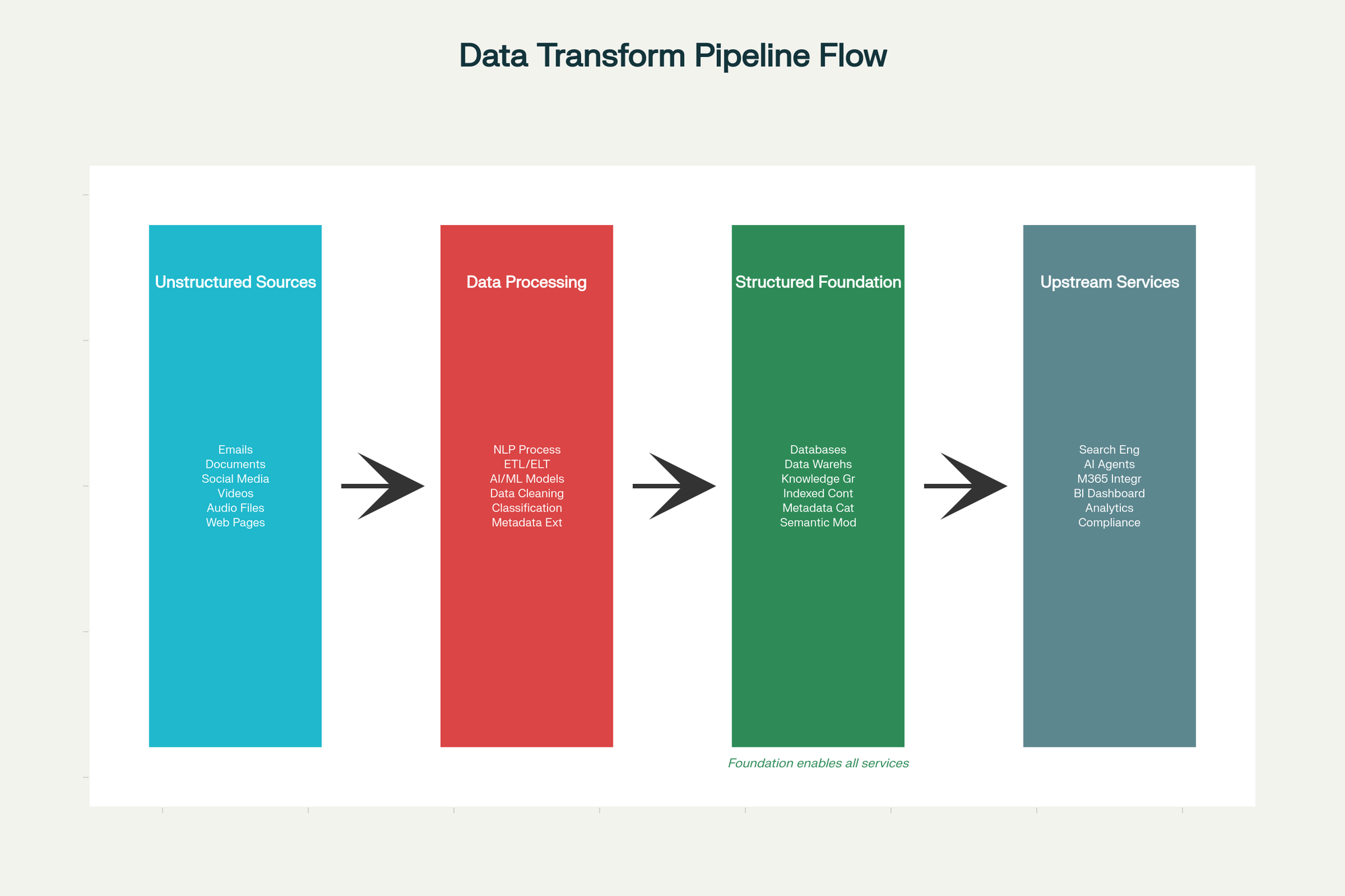
The transformation phase represents the critical juncture where unstructured chaos becomes structured intelligence. This involves removing inconsistencies, handling missing values, applying business rules to ensure data accuracy and usability, aggregating data to summarize key insights, enriching datasets with calculated fields, and normalizing or denormalizing information depending on reporting needs. This step is critical because poorly transformed data can lead to misleading analytics and unreliable business decisions.
The evolution from ETL to ELT reflects the changing capabilities of modern cloud infrastructure. ELT allows raw data to be loaded directly into a cloud-based data warehouse before being transformed using the warehouse's processing power. This approach proves particularly beneficial for handling large volumes of data in any format - structured, unstructured, or semi-structured - as it allows for greater flexibility and scalability in modern cloud environments.
Advanced Processing Techniques
Modern unstructured data processing employs sophisticated techniques that bridge the gap between raw information and actionable intelligence. Natural language processing (NLP) tools analyze text-based data to identify patterns, extract keywords, or perform sentiment analysis, while computer vision recognizes objects, faces, or scenes in photos and videos. Audio analysis can transcribe and analyze audio recordings to detect sentiments or key themes.
Sentiment analysis helps understand how customers feel about brands or products, classification sorts data into categories, and trend analysis identifies patterns or emerging topics from social media conversations or customer reviews. These processing techniques transform unstructured data into actionable insights that businesses can use, including reports showing customer sentiment trends over time, visualizations highlighting key areas of customer interest or concern, and predictive models that help forecast future customer behavior or market trends.
Join me next week as we explore: "Powering Search: From Keywords to Semantic Understanding."